The Beginner Strategy We Use for Booking Hotels in Japan With Points
How normal travelers can use credit card points to save on great hotels in Japan - and occasionally splurge on once-in-a-lifetime stays.
If there’s one area where points and miles absolutely shine for Japan travel, it’s hotels.
Hotel prices in Japan - especially in Tokyo and Kyoto - have climbed dramatically over the past few years. During cherry blossom season, fall foliage, and holidays, even standard rooms can feel shockingly expensive. Meanwhile, some of the best hotel redemptions in the world are still sitting right here in Japan.
The catch is that not every hotel program is equally useful. Some have incredible value but a limited footprint. Others are easier to book but less exciting. And with award availability constantly changing, flexibility matters more than chasing the “perfect” redemption.
In this article, I want to keep things simple and focus on the hotel credit cards and transferable bank points I’d actually prioritize for Japan trips - whether you’re planning your first visit or trying to make annual trips more sustainable.
And if you want the full framework behind how I choose hotels in Japan with points, including pacing, location strategy, and how hotels shape the feel of the trip itself, I go much deeper in The Framework I Use to Plan Every Japan Trip With Points - Part 2: Hotels.
Best Overall Hotel Card for Japan, and The Two Paths You Could Take
Conrad Osaka, one of our favorite Hiltons. Apparently the GM is Italian so they have a Maserati SUV that chauffeurs guests around. We got a free ride to Itami Airport last time in 2024!
Hilton Honors American Express Surpass Card
We are currently planning a trip with our friend couple for the fall of next year. The first hotel card I recommended was the basic Hilton Honors American Express card which is a tier below the Surpass. My reasoning is that after this round, they could also get the Surpass card, which will give them a total of 450k Hilton points and Gold status - which will provide valuable perks like free breakfast and upgraded rooms.
For only a $150 annual fee, the Surpass card easily earns that back through the initial bonus and perks, which also include $50 quarterly credits at Hilton properties.
It’s true that in my deep dive article, I admit I prefer smaller boutiques like Hyatt hotels, and having Marriott points is useful since they have the biggest footprint in Japan - but in terms of which card is most beginner friendly and easy to use, Hilton gets the award.
While Hiltons are more concentrated in major cities like Tokyo, Kyoto, and Osaka, each city provides both affordable and luxury award redemptions.
My plan for our fall trip with our new-to-points, “first time to Japan” buddies, is to use those 450k points to book a total of 10 nights in Yokohama and either Kyoto or Osaka. I’ll admit it was harder to find a cheap redemption in Tokyo that fit our travel plans, so I decided the new Hilton in Yokohama, located in the desirable area of Minatomirai, may be best for proximity to Tokyo, while doing some exploring in Yokohama as well.
As you can see, from only two card applications (per person), saving money on hotels is quite easy. The same hotels for 10 nights would have cost us over $300 a night!
Did I Hear Luxury?
I did mention luxury redemptions exist, too - I haven’t forgotten about you - chasing the finest hotels in Japan with points can be quite exhilarating. Especially if you are planning for a special trip and are looking to be inspired by your stay rather than just having comfortable accommodations, this may be your best path.
If you are willing to open two cards, can handle the annual fee, and have a little more time understanding how to use certain credit card perks, I highly recommend getting the Surpass card and the Aspire card. The Aspire card comes with a hefty $550 annual fee, but like its little brother, easily makes up for it in perks. A couple who applies for both of these cards could end up with 650k or more, plus free night certificates.
I won’t go into a deep dive, but essentially, this opens up the possibility for 10 nights at a very comfortable hotel like the Canopy Osaka (can’t go wrong with Canopy Hotels), Hilton Tokyo, or the brand new Hilton Kyoto.
You would also have enough points to stay at ultra-sought after properties like The Waldorf-Astoria Osaka, Conrad Tokyo/Osaka, or SLH properties like Takanawa Hanakohro Tokyo and Sowaka Kyoto, just to name a few of my personal favorites. With the free night awards, you would have plenty of points to stay for five nights plus another two for a total of seven indulgent nights in world famous hotels.
Best Transferable Bank Points Strategy




Programs like American Express Membership Rewards, Chase Ultimate Rewards, Capital One Miles, and Citi Thank You have points that can be transferred to various hotel and airline programs.
Since Amex is the only one that transfers to Hilton hotels, that would be your next ideal step. While numerous cards earn Amex points, The Gold Card from American Express and The Platinum Card from American Express are the most lucrative. Setting aside details about the annual fee and card perks, both cards are quite handy in providing travel perks and protection, and best of all, come with a serious sign up bonus - sometimes up to 175k for the Gold card and 200k for the Platinum card.
Now you might say to yourself, that’s nice but the Hilton Aspire card often features similar offers of 175k Hilton points. Why do I need to spend more money on annual fees to get these cards?
That’s a fair question if Amex points transferred to Hilton at a 1:1 ratio. But, in reality, it transfers at a 1:2 ratio - meaning, for every Amex point, you are getting two Hilton points. That doubles your Amex bonus to potentially 350k to 400k Hilton points. From one credit card, that’s rich.
My favorite feature of Amex’s relationship with Hilton is that they offer limited time transfer bonuses of varying amounts. I recently had to top off my Hilton account to book a three night getaway for my parents’ anniversary trip. I transferred my Amex points to Hilton when they were running a 20% bonus, meaning I would get 1:2.4 redemption. I transferred 100k, and received 240k Hilton points. Now you can really dream about your next Hilton stay.
Is Hilton the Only Transfer that Matters?
Short answer - no. Sometimes, you may want to transfer points to Marriott, another Amex hotel brand partner. Maybe you just need 20k more to book a nice stay using your annual free night certificate from a credit card. Or, you want to really stay at a particular Marriott where Hiltons aren’t an option. That flexibility is gold for award travel.
Over time, like myself, you may end up with hotel points in various brands. Transferable points add a layer of versatility and peace of mind when you need it most. My philosophy is to start with hotel cards that are straightforward to earn and redeem, and as you run out of points or credit card options, diversify your award travel piggy bank by getting transferable bank points.
Best Backup Hotel Brand
A quick bit on Marriott hotels. I don’t recommend Marriott cards to beginners because it has a very complicated web of credit card application restrictions, and more importantly, points are harder to earn and do not go as far.
With that said, they have the biggest footprint in Japan - and with that come many redemption options: low, mid-tier, and high.
Because of this, for any repeat travelers to Japan on points, diversifying your hotel points by incorporating Marriott cards is the next step. Many of these credit cards come with annual free night awards ranging from 35k to 85k per night, and are able to be topped off with up to 25k.
For example, Cory and I now have a total of six certificates each year for Marriott alone, which help to cover “buffer nights” - nights when convenience outweighs luxury - like before a flight, or when shifting between cities or big stays.
Some of our favorite stays are from these certificate award stays - such as The Prince Gallery Tokyo Kioicho, MESM Tokyo, and AC Hotel Tokyo Ginza - all of which far exceeded our expectations, and leaned heavily into both convenience and restful luxury.
Which Hotel Cards Are Actually Worth Keeping?
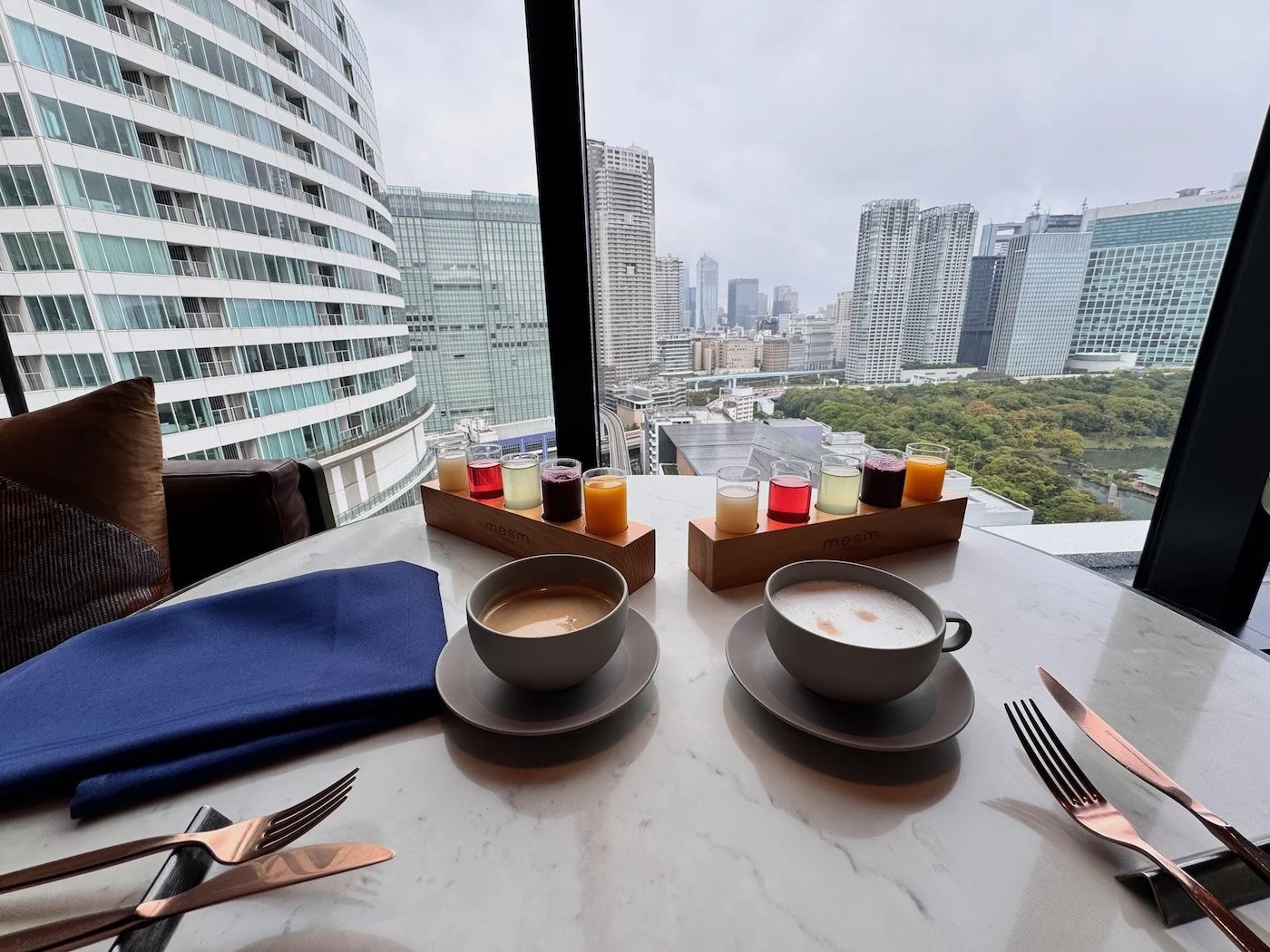
MESM Tokyo - the juice flight was really fun
Annual award certificates that accompany credit cards are a major part of the decision making that comes to play when contemplating whether to keep a card or not.
While the exact answer to this question depends on how much you value certain perks and the amount of annual fees you are comfortable with - I usually define a hotel card as a keeper if the perks far outweigh the annual fee.
Take, for example, the Hilton Aspire card. The annual fee is a hefty $550.
But unlike many premium travel cards that bury you in perks you may struggle to use, the Aspire card’s benefits can directly improve a Japan trip almost immediately.
The biggest perk, by far, is Hilton Diamond status. In Japan, Hilton status tends to feel more meaningful than it does in the U.S. Amazing breakfasts, nicer upgrades, executive lounge access (when there is one), and generally more polished service (being checked in on a separate exclusive floor, while enjoying a welcome drink and snacks) all add up quickly.
Then there’s the annual free night certificate, which is honestly one of my favorite hotel perks in the entire points and miles hobby. Unlike many free night certificates that cap you, Hilton’s can be used at some truly exceptional properties.
In Japan alone, you could potentially use it at places like:
Conrad Tokyo
Conrad Osaka
Waldorf Astoria Osaka
ROKU Kyoto, LXR
SLH properties like FAUCHON L'Hotel Kyoto, or The Tokyo Station Hotel
These are hotels where one night can easily cost $700-$1,500+ during peak seasons.
The Aspire also pairs extremely well with the Surpass card strategy I mentioned earlier. A couple combining bonuses from both cards can realistically build a full luxury-focused Japan itinerary without paying cash rates that would normally feel impossible.
Another underrated perk is how easy Hilton points are to earn and actually use. Hilton may not always give the absolute highest theoretical value per point, but both earnability and availability are often more beginner friendly than, say, Hyatt. That matters a lot in Japan, especially during cherry blossom season and fall foliage, when flexibility becomes more important than chasing the perfect redemption.
The quarterly airline credits and Hilton resort credits help soften the annual fee as well, though personally, I think the real value comes from the combination of:
Diamond status
free night certificates
large welcome bonuses
and practical redemption availability in Japan
Altogether, the Aspire card can open the door to the kind of Japan hotel experiences that normally feel out of reach - especially for travelers trying to balance comfort, inspiration, and practicality.
Mistakes People Make With Japan Hotels
There’s no such thing as a perfect trip - sometimes a little friction simply becomes part of the experience
One of the biggest mistakes people make when planning a Japan trip is treating hotels as “just a place to sleep.” In Japan, your hotel often shapes the pace, energy, and feel of the entire trip more than you’d expect.
The first mistake is staying too far away from where you actually want to spend time. Saving a little money on the hotel can quickly backfire once you realize you’re adding long train rides at the beginning and end of already exhausting days. We often get tired and cheat by using taxis - but this tendency also causes any “savings” to dissipate. In massive cities like Tokyo and Osaka, convenience matters far more than people think.
Another common mistake is changing hotels too often. Japan has endless amazing neighborhoods and hotel options, so I completely understand the temptation - I did it myself and made Cory go crazy. Hidden underneath the glitz is what slowly wears you down - constantly packing, checking out, shipping luggage, or worse, dragging luggage through stations, and relearning areas. Sometimes staying an extra night in a comfortable, familiar area is worth more than squeezing in another luxury hotel.
I also think people underestimate how physically exhausting Japan can be. The walking, crowds, stairs, heat, and sensory overload add up quickly. That’s why I often value a well-located, comfortable hotel over chasing the absolute highest value redemption.
Kyoto is where this becomes especially important. During cherry blossom season, hotel prices rise dramatically and availability disappears fast. This is also why I generally discourage treating Kyoto as a day trip from Tokyo (or anywhere). Not only is it expensive and inefficient, but some of Kyoto’s best moments happen early in the morning or late in the evening, when the city finally quiets down. Some of my favorite moments there weren’t elaborate plans at all - just wandering the streets to enjoy everything organically.
The Stays We Remember
Over time, I’ve realized that the best hotel stays in Japan aren’t always about luxury alone - they’re the ones that somehow made the trip feel calmer, more immersive, and even inspiring in ways I didn’t expect.
The beautiful thing about award nights in Japan is that they can completely change the rhythm of a trip without needing to stay at luxury hotels every single night. Sometimes the stays you remember most are simply the ones that gave you space to slow down, recharge, and enjoy where you are.
