How I search, compare, and strategically book award flights and hotels to Japan
The Japan Withdrawal Is Real
If you get chronic symptoms of Japan withdrawal like I do, the question that dominates your mind is when can I get back to Japan?
I don’t blame you.
Without fail, every time I get back from a trip to Japan, I have Japan-sickness for weeks, if not months.
It’s not that I don’t enjoy my life here in the States - we live in a peaceful suburban area with decent access to Boston, should we crave a little more excitement.
But we don’t go to Boston like it’s Tokyo.
If Tokyo were only 45 minutes away, we would be there literally every weekend. And Tokyo isn’t even my favorite city in Japan!
It’s beautiful when you can find a peaceful abode in a mega-metropolis
The Cure: Planning the Next Trip
Anyway, let’s get to the cure - the fix. How do I plan out our trips to Japan?
My favorite seasons to visit Japan are spring (March - late May) and fall (October to early December).
Although we’ve done summer and winter before, if we could choose, we wouldn’t do it too often. Is it a deal breaker? No. It just requires a slightly different approach to the entire trip.
Part of what makes Japan so fun for us is how it’s so walkable - we just don’t do that enough in the States. And when the weather is too hot, too cold, or too rainy, it literally puts a damper on our trip.
How This Guide Works
Over time, I’ve developed a simple framework for planning our Japan trips using points. Most of the points we use come from a long-term strategy of credit card bonuses and rewards.
This article is the complete overview of that system.
Each step connects to a deeper guide if you want to explore further:
If you follow these steps in order, planning a Japan trip becomes surprisingly manageable.
The Search Begins: Flights First
With a rough travel window in mind, I use award search tools to find possible departure dates, then work backward from the return flight to see what actually fits.
Do I still look for Business Class first? Usually. I’m not going to pretend I wouldn’t love a lie-flat seat and a few extra meals.
But I’m much more willing now to book a flight I’m already happy with and keep looking for better flights afterward. Our recent JAL Premium Economy flights were comfortable enough that I never felt like we had compromised the trip. And if Economy gives us a direct flight on the dates we want, that’s worth considering too.
If a better award opens up later, I can switch it, since most award booking cancellation rules are quite lenient. If nothing better pops up, we’re still going to Japan.
I’ve also started looking beyond what partner programs show. JAL’s own award calendar gives me another place to search, including connections to cities beyond Tokyo. Before transferring any points, though, I check the actual booking screen to confirm the seats, mileage required, and cash charges. A promising calendar result is only the beginning.
From Hotel-Hopping to Staying Put… Sort Of
Once I confirm the flights, I create a calendar in a Google Doc and map out arrival times, transit windows, and hotel stays for each city.
I use an award search tool to see what’s actually possible.
I used to splurge on high-end hotels, staying just one night at a time and hopping from one to the next.
Fun? Yes. Relaxing? Not really.
As I got more trips under my belt (and calmed down a bit), I shifted to booking three to five nights at the same property - giving myself time to enjoy the hotel and absorb its surroundings.
But as you’ll see in my trip reviews and in our recent summer trip, we still haven’t completely kicked the habit of hotel hopping.
It certainly has its place, but some hotels just deserve more than one night.


Why Proximity Beats Luxury on Night One
Since most of our flights land at either Narita or Haneda, I often prioritize proximity to the airport over luxury stays from the start (plus, what if there’s a delay and you don’t make it to your first night?)
From Boston, a direct flight to Narita airport involves getting to the airport, going through security, and waiting for a 14-hour+ flight.
Then, after the lower half of your body goes numb (in economy - yes I’ve done it many times!) your neck aches and refuses to turn, and you feel like you’re carrying the grime of the world (you probably are), the last thing you want is to have to deplane, go through the snaky immigration line, find your baggage, go through customs… and have another two hour bus ride to Tokyo.
I’ve definitely done it - many times.
But even with a really nice hotel waiting for you, the idea of going through all of that kills me.
On recent trips, I’ve made a conscious effort to land at Haneda, even though there aren’t any direct flights there from Boston.
This has often allowed us to deplane and reach the hotel in under three hours, rather than four to six.
With that said, landing in Narita is not a deal breaker at all.
From Boston, a direct flight to Narita can make plenty of sense. On our July trip, we took the Narita Express to Shinjuku and a short taxi ride to the Kimpton. Everything lined up unusually well, and it reminded me that Narita doesn’t automatically mean a miserable arrival.
On our return flights, I have no preference, since we are often well-rested and have plenty of time to get to the airport for a 5 PM or 6 PM departure.


The itinerary below reflects our original planning for a 2026 trip, rather than our final bookings. I’ve kept it here to show how I worked through the decisions at the time. Some of our plans - and my approach - have evolved since then.
A Sample Itinerary: August–September 2026
Outbound Flight
American Airlines Premium Economy (Flagship)
JFK 10:40 AM → HND 2:00 PM
Booked with Cory’s Alaska Airlines miles - 100K + $37.86
Days 1–2: Tokyo (2 Nights)
Super excited to revisit - it’s been over a decade since our last stay.
Park Hyatt Tokyo
70K Hyatt points (Shota)
Days 3–7: Sendai (5 Nights)
Family time.
The Westin Sendai
157K Marriott points (Shota)
Corner Suite Upgrade using Nightly Upgrade Awards
(earned from 50 nights in 2025)
Day 8: To Kansai
No trip feels complete for us without time in this region.
Flight or train — not booked yet.
Most likely via Amex or Chase travel portal.
Days 8–12: Osaka / Kyoto (5 Nights - TBD)
New and exciting hotel options vs. tried-and-true.
Options:
DoubleTree by Hilton Kyoto Higashiyama - 160K for 5 nights + breakfast
Conrad Osaka or InterContinental Osaka – Book through Amex Fine Hotels + Resorts, apply an available $300 hotel statement credit from an eligible Platinum card account, and use around 20K Amex points to cover the remaining cost, depending on the rate.
Sowaka - 150K per night or Hilton Free Night Certificate
A decision I’m still happily weighing.
Days 13–14: Mount Fuji Area (2 Nights)
We’re going for it. Again.
Will we go 4-for-4 with clear views, or lose to fog?
Fuji Speedway Hotel - Amex FHR credits
Free breakfast, onsen access, $100 property credit
Day 15: Yokohama (1 Night)
The obligatory buffer night that nudges us closer to the airport.
Either The Kahala Hotel & Resort Yokohama (FHR credit)
or InterContinental Yokohama Pier 8 (around 50K IHG)
Day 16: Return Flight
Sometimes comfort beats multi-stop routes in business.
Japan Airlines Premium Economy
NRT → BOS
Booked with Cory’s American Airlines miles - 100K + $89.06
What’s Different
My first step with this trip was to search for flights out of NYC, which was a fun change.
We would be in NY in August anyway, and figured it would be great to take a direct flight to Haneda.
In fact, the very flight we booked is the one our friends flew on during our 2025 trip together. With the seats being the new flagship-model premium economy, we are excited to see how they compare to JAL or ANA.
Proximity and Luxury - a Dream Start to Any Trip
Knowing we’d land in Haneda around 2 PM helped me to book our first two nights in Tokyo at the Park Hyatt.
I’m genuinely excited to be back at this hotel after its year-long renovation and hope to write an in-depth review - more than a decade after our first visit.
At first, I looked at options near Narita since Boston has direct flights there. The Hyatt Regency Tokyo Bay, for example, offers club rooms and suites for 14k–23k points - a fraction of the 45k–70k+ rates you’ll see closer to central Tokyo.
Even so, Haneda offers more direct access to the heart of Tokyo and a much more premium hotel right from the start, which is the best of both worlds!

Sendai: The Closest Thing to Home in Japan
Whenever I’d visit Japan growing up, we would go to the northern city of Sendai, in Miyagi prefecture.
My grandparents and my older brother’s family are there, and it is my home away from home.
I’ve only recently started seeing foreign visitors in the city, but it is a hidden gem, full of amazing food, people, and shopping.
I understand that's a very broad assessment, and you’re not wrong.
It would be hard not to find those things anywhere in Japan, but what sets Sendai apart for me is the fact that it’s cozy - everything is walkable and accessible.
It isn’t as overwhelming as Tokyo, as noisy as Osaka, or as busy as Kyoto. It’s just right.
If you ever get a chance to stretch your legs north, I highly recommend spending a few nights near the station to get a taste.


Small City Problem: Not as Many Options
Sendai included, most smaller cities in Japan don’t have many Western hotels.
As such, using points for hotel nights becomes less rewarding or difficult altogether.
Thankfully, Sendai has two Western options, including The Westin Sendai.
Personally, I am excited to stay there again, with a possible suite upgrade, because similar rooms in the area cost $300-$450 a night, even though the city is overall much cheaper than Tokyo.
Since my brother and his family live near Sendai Station, this hotel is perfect for our stay.
Other options I’d consider are the Metropolitan Sendai East and Hotel Metropolitan Sendai, right by the station. Even without a useful hotel-program redemption, I can compare paying cash with using points through a travel portal, if the property is available there.
Recently, I’ve become more open to that approach. Transferring points can offer excellent value, but I now compare the actual options before assuming it’s the better choice.
How many points would each booking require? Is breakfast included? Are there useful property credits? Would I receive the elite benefits I’m counting on, and how flexible is the cancellation policy?
My Andaz Tokyo comparison shows why this matters. A booking through The Edit can be appealing once I account for the points required and benefits we would actually use.
I still love a great transfer redemption. But if a portal booking gets us the hotel we want on better overall terms, I’m happy to use it.
Osaka & Kyoto: Too Many Good Options
Although we have to stretch north to visit family (usually Sendai and Sapporo), we always make trips to the Osaka & Kyoto area to get our fix for some of the best hotels.
This time, I am undecided: I have eight $300 annual vouchers from Amex's Fine Hotels and Resorts (FHR) program, and I’m wondering whether to use them here. (To clarify, these are statement credits for eligible prepaid bookings through Amex Travel - not $300 off every night. Each eligible card account provides up to $300 from January through June and another $300 from July through December. The credit applies based on when the booking is charged, so the stay itself can happen later.)
The two hotels I listed are ones we’ve stayed at before and would love to stay at again, with all the perks of an FHR booking: daily breakfast for two, guaranteed 4 PM checkout, a $100 property credit toward eligible charges, and noon check-in and a room upgrade when available.
Those benefits can make a short stay feel surprisingly generous. The challenge, as usual, is deciding which hotel we go with.
Conversely, a property like the DoubleTree by Hilton Kyoto Higashiyama or other Hilton properties that we’ve never visited would be a great experience, as we’ve heard great things about how they are not just any “Hilton” or “Double Tree” you’d see in the States.
The final option I’m toying with is the Sowaka Hotel, a beautiful Small Luxury Hotels (SLH) boutique with stunning rooms and a strong commitment to Kyoto architecture and Japanese quiet luxury.
I had 5 nights booked there a year ago, soon after they first joined Hilton on February 7th, 2024.
The award night stays have ballooned from 95k to 150k/ night, sadly following recent Hilton devaluations, but standard rooms seem to be available for a Hilton Free-Night Reward if you have the Hilton Honors American Express Aspire card.


Taking a Calculated Risk on Mount Fuji
I’ve often debated whether I should return to the Fuji-Kawaguchiko area.
So far, we are 3-for-3 in seeing the breathtaking mountain in person, but we realize some have struck out time and again because of thick fog. I used to think, it’s just a mountain, how special can it be?
But oh boy was I wrong.


That photo is from 2016, when iPhone cameras were nothing like they are today. It doesn’t do it justice, but imagine waking up to that view after not seeing a thing the first day.
So yes, it’s 100% worth it if you can see it.
For 2026, we are going to take another leap of faith and stay at the Fuji Speedway Hotel using Amex FHR credits.
The hotel is a touch remote, but everything near Mount Fuji is remote, so we’ve come to accept that fate.
What drew me to this hotel was the views from its private onsens. They seem to have indoor and outdoor options, and visitors are raving about the views and the food.
I didn’t need much more convincing after that!
Ending the Trip the Easy Way Home
After one final night somewhere in Yokohama (I call it Little Tokyo), we will take the direct flight back to Boston on Japan Airlines' premium economy.
One quick note is that these seats are in a shell - meaning you slide forward into your own space, and you never bother the person behind you since you don’t recline into their space.
I appreciate that feature a lot as I am very self-conscious about when and how much to recline - I almost never get to lean it back fully, defeating the purpose of any advertised “seat pitch.”
As a tiny little tip (you may not care at all, and that’s ok), for products like the newest American Airlines premium economy seats, even though they lean back into your neighbor's space, if you book last-row seats, you will not have to worry about anything.
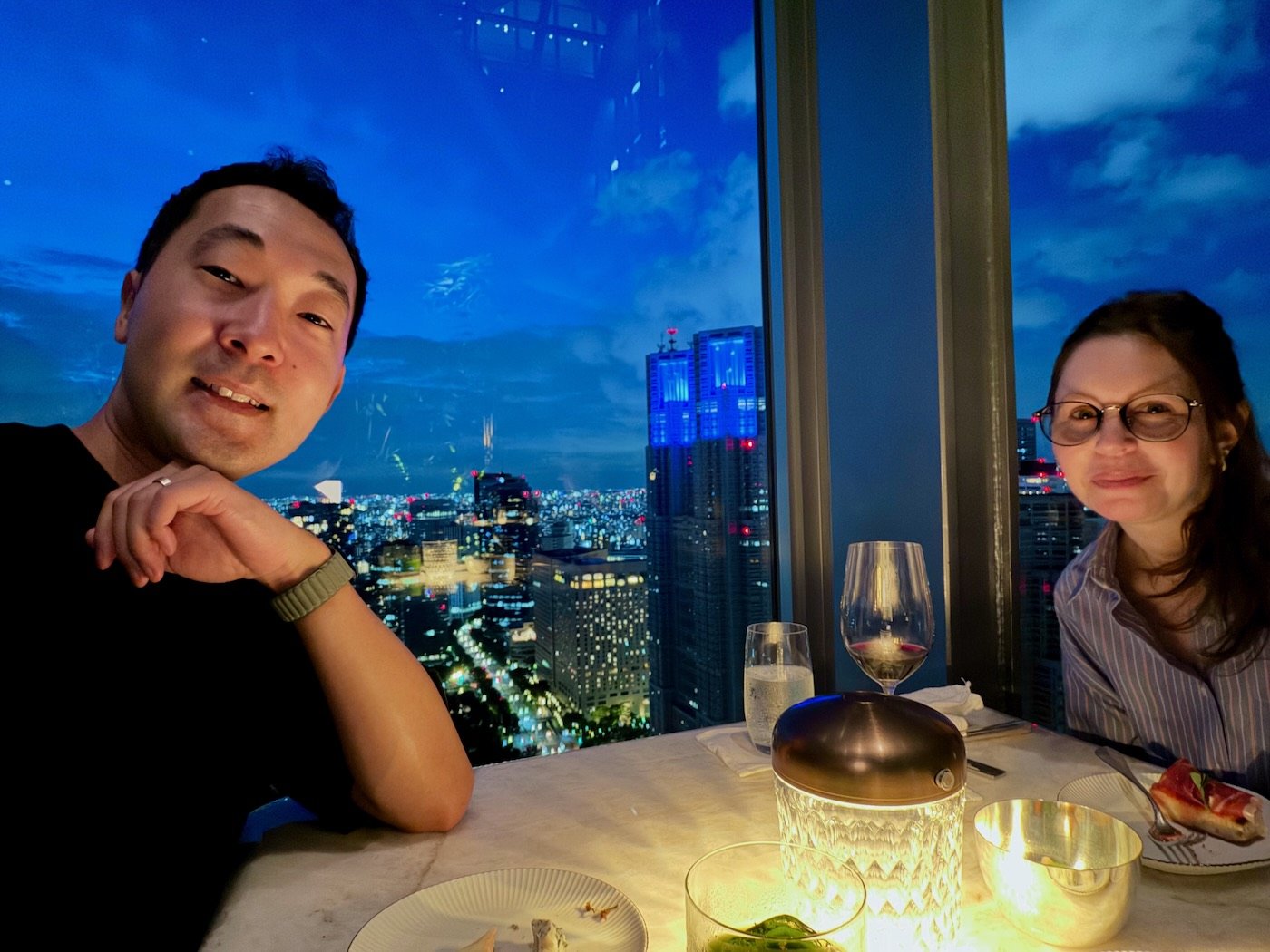
The incredible view from above 40 stories
Why This System Works for Us
All in all, this 2026 trip only took me a couple of hours to figure out and piece together.
With all the preliminary research out of the way and my dates firmed up, the only things left to book are relatively low-stress.
I may switch out a hotel or two by the time we actually travel, but that too is what makes award travel so flexible and fun.
Whelp. Change it I did.
In retrospect, I ended up changing this particular trip three times, each with a slight variation on the hotels and routing. So much for having it all figured out in a couple of hours.
To see how the trip actually felt - and what we’d do differently next time - read After Our Trip in July: I Wouldn’t Tell Everyone to Avoid Japan in Summer.
What’s Next
I hope this glimpse into my travel-planner brain was helpful - and that the three deep dives below make planning your own award trip a whole lot easier.
Continue Your Journey
How to Plan Your Credit Card Applications for a Japan Trip (12-Month Roadmap)
Points-Rich, Strategy-Poor: Why 300k Miles Can Still Get You Nowhere
How Many Hilton Points Do You Need for a Japan Trip? Budget-Friendly vs. High-End Award Stays
Bones Before Meat: How I Plan Japan Trips That Actually Work
